
Quackademics on Parade
The sleep of reason in healthcare decisions.

© June 4, 2025 / Edward De Vos
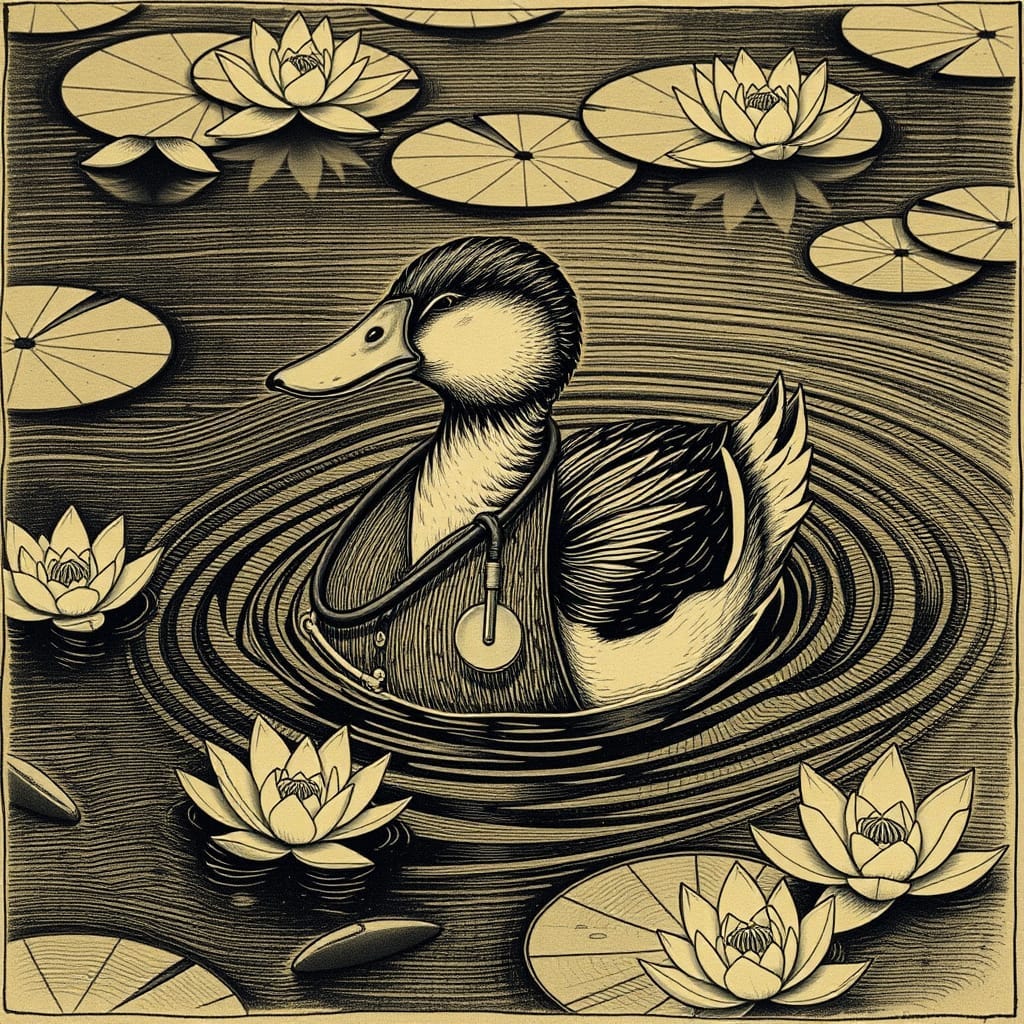
If it it walks and swims like a duck, and quacks, reason has it that it’s probably a duck. Since the Renaissance, Western medicine has increasingly relied on science to guide decisions. Practices that may have originated as folk remedies, archaic texts, and chance encounters, if put properly to the test, might make their way into routine medical practice.
Entries in the modern pharmacopoeia, for example, did not all start with bench science. Drugs were vetted in labs to determine if they met standards for inclusion, even though many started as traditional healing practices devoid of starched white coats and expensive scientific equipment.
The humble aspirin was first extracted from willow bark and was used in ancient Greece and elsewhere to relieve pain and fever. Derived from bread mold, penicillin has been used for wound treatment in many traditional cultures. Other examples include: Digitalis from the foxglove plant (Europe); quinine from the cinchona tree (South America); ephedrine from the ephedrine plant (China); physostigmine from the Calabar bean (West Africa); and Devil’s Claw anti-inflammatory supplements for arthritis and back pain (South Africa).
Centuries of progress are threatened in this topsy-turvy moment through willful ignorance and policies strategically designed to foment chaos and herald an age of misinformation and fakery. Even as glaciers retreat due to the effects of global warming, we’re entering an intellectual ice age where opinion has been substituted for “truth”. The bright promise of the Renaissance is shrouded in the emerging neo-darkness. Every day, reliance on reason and science come under attack from the very individuals and offices charged with promoting, nurturing, evaluating, advocating, and equitably disseminating that knowledgebase.
On treacherous terrain, the cavalcade of science is being pushed to the shoulders. Some of the greatest public health accomplishments of the past century are being taken from the shelves to be burned at the stake of public opinion. U.S. and international health organizations generally regard these as the greatest public health achievements of the 20th century:
Vaccination
Infectious disease control
Motor vehicle safety
Workplace safety
Declines in heart disease and stroke
Safer and healthier foods
Maternal and baby health
Family planning
Fluoridation
Health hazards of tobacco use
The “One, big, beautiful bill” making its way through a spineless Congress, a gaggle of incompetent bobblehead agency heads, and the continuing flood of executive orders spewing forth from the Resolute Desk place most of these hard-won gains in jeopardy. Make no mistake, these advances are at imminent risk. Beyond eliminating and scaling back programs, the government has been attempting to expunge the public record by removing data so important for monitoring need and impact, guiding future development, and providing evidence for continuation and expansion.
Professional practice should be evidence based. Intervention programs ought to have demonstrated efficacy, effectiveness, and cost-effectiveness (and even cost-benefit when we move beyond ethical imperatives). Until only recently, we’ve lived in an age that aspires to demonstrated proof, where the standards of evidence had become increasingly rigorous. Since the first Trump administration, and over the first five months of Trump 2.0, public pronouncements have generally ignored science and reason. They’ve even attacked it. Opinions are replacing facts as we tumble down the rabbit hole with Alice. The Queen of Hearts has been replaced by the mad king and his alternate reality. Meanwhile his entourage of courtiers and jesters grovel at his feet obsequiously praising his brilliance and the exquisite fineness of his threads. Oh what have we become? We’re late, we’re late, for a very important date…
On the consumer end of this crisis, even as many advocate for science-based practice, many are alarmed by the public’s limited interest in science and science literacy in general. Approximately 2 out of 3 Americans (67% in 2019) claim to understand the scientific process. Despite this assertion, pseudoscientific beliefs continue to thrive, revealing a large swath of the public susceptible to unfounded claims that can adversely affect their health, safety and well-being. For example:
o 27% believe in astrology (Pew Research Center, 2025);
o 41% believe in ghosts (YouGov, 2021);
o 41% believe in ESP (Gallup, 2005);
o 42% believe in UFOs (Ipsos, 2023);
o 50-60% believe in the healing power of prayer (Gallup, various years)
In our current intellectual climate in which scientific evidence is so highly regarded by some, yet pseudo-scientific claims maintain such credulity, it is not surprising that many individual choices represent a curious blend of both.
Some, including myself, have argued the importance of respecting diverse cultural and personal practices, and overcoming the hegemony of Western medicine. Others (also including myself) have argued that those who would ignore rigorous proof of efficacy are diluting the base for scientific medicine and are throwing the gates wide open for what some pejoratively refer to as quackademic medicine. These critics contend that poorly designed and executed studies of complementary and alternative medicine give undeserved and unsupported legitimacy to areas of practice that they consider to be only the most recent examples of snake oil medicine and science. The snake oil salesman in chief is well aware of this duality and continues to exploit it. The trick is to find ways to bridge the gap between what we know and what we hold dear. And reserving the political sphere for evidence-based practice.
Rigorous science has its logical appeal, yet the requirement for rigor depends, at least in part, on what is already known and the costs of being wrong. Many beliefs we hold and behaviors we undertake may have little basis in Science (with a capital “S”). Yet there may be little risk associated with those beliefs and practices. If there is an approach that has strong evidence of working, we should definitely consider it. But many beliefs and practices are relatively innocuous; we can do or not do them entirely as we see fit. Whether it “works” or “doesn’t work” is really of little consequence. The fact is, it may make us feel better, and depending on the condition, that may be all that is required. When he had a chest cold, my father-in-law would take a shot of whiskey with a slice of lemon before retiring to bed. Whether the practice “cured” the cold or just helped him to sleep wasn’t the issue--he believed it made a difference, and so he did it. He also was a practicing physician (an ENT, ironically enough), but why should that make a difference?
love the term "quackamedics." I listened to one of the "Clickbaits" on my internet. I clicked on it to find myself listening to a hour long program promoting the latest patent medicine. There are many promotions out there and caveat emptor applies.